

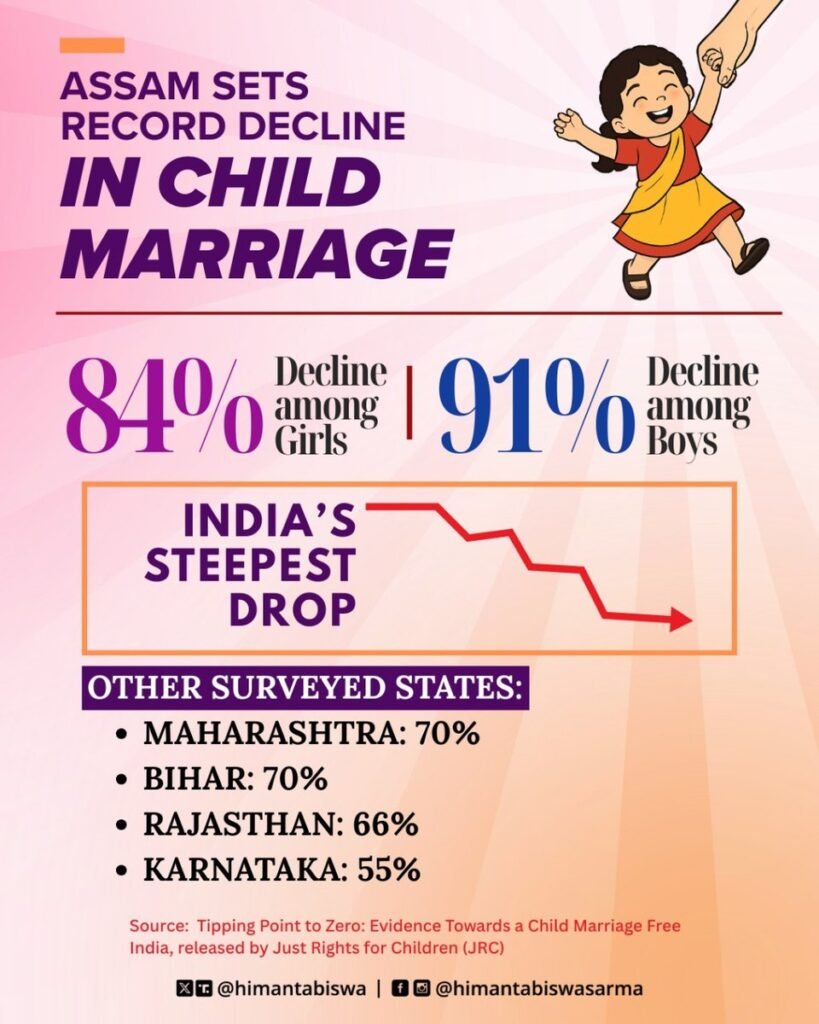
Assam’s sustained campaign against child marriage has shown significant results, with recent data indicating a sharp decline in early marriages and improvements in key health indicators across the state.
The campaign, backed by the Assam government under Chief Minister Himanta Biswa Sarma and implemented through Assam Police during the tenure of former Director General of Police G.P. Singh, combined strict law enforcement measures with large-scale awareness programmes aimed at changing social attitudes.
The initiative gained momentum in late 2022 after authorities identified districts and villages reporting high incidences of child marriage through extensive data analysis and field-level assessments. Based on these findings, the state government launched a statewide crackdown targeting individuals involved in facilitating underage marriages.
Beginning in 2023, Assam Police carried out a series of operations across multiple districts. Cases were registered under various legal provisions, including the Protection of Children from Sexual Offences (POCSO) Act wherever applicable. Thousands of individuals were booked during the operations, while arrests crossed the 2,500 mark during the initial phases and continued to rise in subsequent rounds.
Officials involved in the campaign emphasised that enforcement alone would not be sufficient to eliminate the practice. As a result, awareness drives were simultaneously conducted in schools, villages and community centres. The programmes focused on educating families about the legal age of marriage, the importance of girls’ education and the long-term social and health consequences of child marriage.
Recent survey findings suggest that these interventions have begun producing measurable results. While earlier national survey data indicated that a significant proportion of women in Assam were married before attaining adulthood, newer figures point towards a substantial decline in the prevalence of child marriage across the state.
Independent studies have also reported a dramatic reduction in child marriages over the past few years, with some estimates suggesting declines exceeding 80 per cent in certain areas. Rural districts, traditionally more vulnerable to the practice, have witnessed focused interventions under the campaign.
The state’s efforts have also coincided with improvements in maternal and child health outcomes. Experts note that reducing child marriage often contributes to lower rates of teenage pregnancies, which in turn can help improve maternal health and reduce infant mortality.
Assam has recorded notable progress in both infant and maternal health indicators over the years. Public health experts believe that campaigns aimed at delaying marriage and promoting girls’ education have played an important supporting role in this improvement.
The initiative aligns with the state government’s broader objective of eliminating child marriage and advancing women’s empowerment through education, awareness and legal protection. It has also contributed to Assam’s progress on key social development indicators linked to gender equality and public health.
Officials acknowledge that challenges remain, particularly in remote rural areas where social practices and economic factors continue to influence early marriages. However, they maintain that sustained enforcement, community engagement and educational interventions will remain central to the state’s strategy going forward.
As Assam continues its efforts to eradicate child marriage, the campaign is increasingly being viewed as an example of how coordinated action involving law enforcement, government departments and local communities can contribute to long-term social change.













Leave a Reply